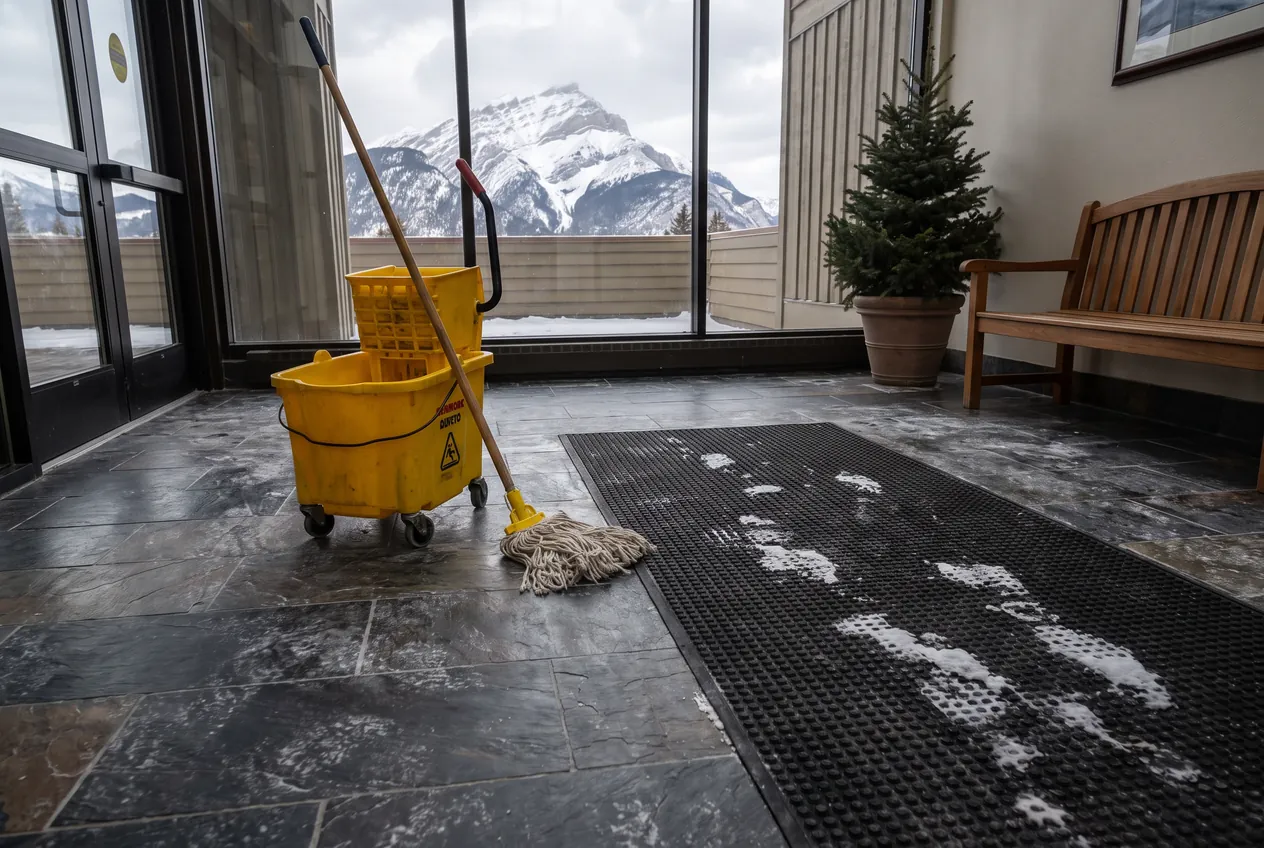
What ice melt does to commercial floors
Rock salt and the calcium chloride and magnesium chloride blends used on sidewalks and parking lots all melt ice well, and all of them follow people inside. As the meltwater dries, it leaves a white film on hard floors. That film dulls the floor finish, wears it down under foot traffic and can make the surface slippery, especially just inside the door.
Carpet suffers differently. The residue wicks into the fibers and dries into white or tan rings that grow larger each time more slush is tracked in. Vacuuming lifts the loose grit but not the dried salt, so the rings stay until the carpet is properly extracted. Left alone, residue on both surfaces spreads deeper into the building every day.
Stop the salt at the door with matting
The cheapest residue to remove is the residue that never gets past the entrance. A matting system works in stages: an outdoor scraper mat knocks off snow and grit, then indoor wiper mats absorb water and the last of the salt from shoe soles. The matting needs to be long enough to catch several steps from each person, because one short mat at the door only catches the first footfall.
Mats fill up during a storm. Once a mat is saturated it stops absorbing and starts spreading wet residue onto the floor beyond it, so mats need regular vacuuming and swapping for dry ones during long stretches of bad weather.
- Outdoor scraper mat placed before the entry doors
- Indoor wiper mats running several steps past the door
- Vestibule mats covering the full width of the walkway
- Spare dry mats on hand to swap in during storms
- Mats vacuumed daily and cleaned when saturated
- Mat edges flat and secure so they do not become a trip hazard
A daily routine for entrances in snow season
Ice melt residue is far easier to remove the day it comes in than after it has been ground into the finish for a week. A short daily routine at every entrance keeps the problem small. The table shows how most buildings divide the work between the night crew and daytime attention.
| Area | Task | How often |
|---|---|---|
| Entry mats | Vacuum and swap wet mats for dry ones | Daily, more during storms |
| Hard floors at entrances | Dust mop to lift grit before mopping | Every cleaning visit |
| Entrance tile and vinyl | Damp mop with neutral cleaner or ice-melt remover | Every cleaning visit |
| Large lobbies and corridors | Auto scrub to lift residue and pick up the water | Several times a week in winter |
| Carpet near doors | Vacuum thoroughly, spot treat fresh salt marks | Every cleaning visit |
| Carpet with salt rings | Hot water extraction | As rings appear, and after winter |
Removing the film from hard floors
Ordinary all-purpose cleaners can leave residue of their own or react poorly with salt film, so the usual choice is a neutral floor cleaner or a product made specifically to remove ice-melt residue. The trick is not over-wetting. Flooding the floor dissolves the salt and spreads it into seams and edges, where it dries again as soon as the mop moves on.
On large entries an auto scrubber does the job better than a mop because it scrubs, applies solution and picks up the dirty water in one pass, leaving the floor nearly dry. On smaller entries, work with a well-wrung mop, change the solution often and rinse the mop head, since dirty water just moves the salt from one spot to another.
Getting salt rings out of carpet
White salt rings near entrances need extraction, where hot water and a cleaning solution are pushed into the carpet and pulled back out with the dissolved salt. Spot treating with a damp towel can lighten a fresh mark, but it rarely removes the salt from deep in the pile. Carpet that is extracted several times over winter stays in far better shape than carpet left until spring.
Extraction leaves carpet damp, so time it for when the area can dry before traffic returns. In many offices that means an evening visit or the end of the week. Put down dry wiper mats over freshly extracted carpet at the doors only once it has dried, since a mat laid on damp pile traps moisture and can leave its own mark.
Winter floors in Colorado Springs
Winter storms in Colorado Springs bring snow, grit and ice melt into lobbies, and the entrances of offices, clinics and shops take most of it. Grit and ice melt together scratch hard floors and wear down finish, so entrance tile often looks worn by the end of the season even where the rest of the building looks fine. Buildings with several public entrances should make sure every door gets mats and daily attention, not only the main one.
The dry air along the Front Range means meltwater does not stay wet for long. Residue tracked in during the morning can already be a white film by midday and spread as dust on the next shoes that cross it. That makes daytime attention useful in busy buildings, whether from a day porter or staff with a dust mop, rather than leaving everything for the night crew.
The spring scrub and recoat
When the snow season ends, plan a deeper floor visit. Resilient floors such as VCT usually get a scrub and recoat to remove the dulled, salt-worn top layers and lay down fresh finish, and entrance carpet gets a full extraction. Scheduling this before the finish wears through to the tile can avoid a full strip and refinish later. Mats should be cleaned thoroughly before they go into storage.