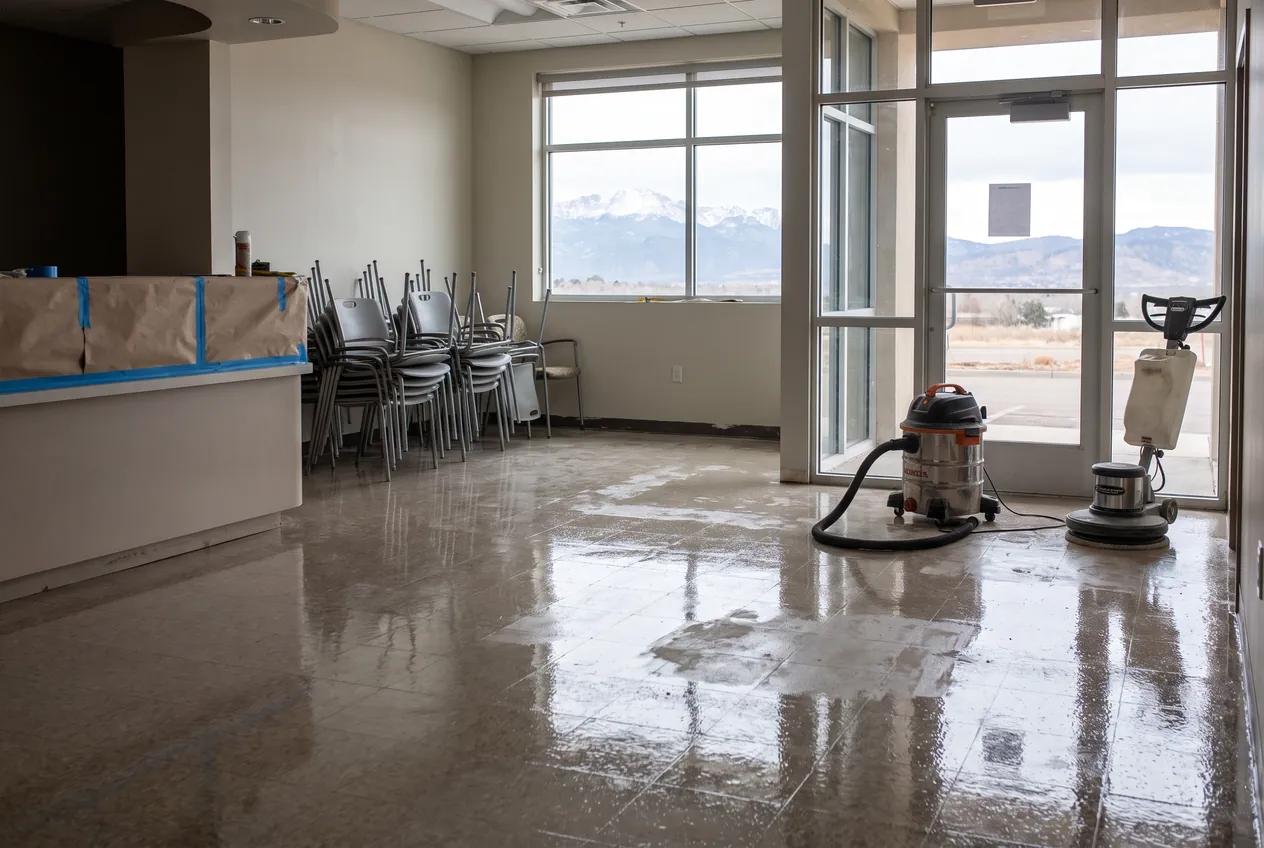
What stripping and waxing actually means
The floor most often stripped and refinished in commercial buildings is VCT, vinyl composition tile, the hard tile common in corridors, break rooms, classrooms and retail aisles. People still call the job waxing, but the coating used today is usually an acrylic floor finish rather than wax. It protects the tile, gives it a shine and takes the scratches that would otherwise reach the tile itself.
Over months of traffic the finish gets scratched, dulled and embedded with dirt, and each maintenance coat adds a layer on top of the last. Eventually the build-up looks yellow or cloudy at the edges and no amount of mopping brings it back. Stripping removes every layer down to bare tile so a fresh, clear finish can go on.
The steps of a commercial strip and wax
Each step depends on the one before it. Skipping the neutralizing rinse, for example, can leave stripper residue that stops the new finish from bonding, and laying coats too thick or too close together leaves a soft, streaky floor. A crew that follows the sequence below and respects drying times produces a floor that holds up.
- Move furniture, mats and anything on the floor out of the area
- Dust mop to remove loose grit and debris
- Set out wet floor signs and close off the area
- Apply stripper and let it dwell for the time on the label
- Scrub with a low-speed floor machine and stripping pad
- Pick up the dissolved finish and slurry with a wet vacuum
- Rinse the floor, often twice, and neutralize it
- Let the bare tile dry completely
- Apply several thin coats of finish, letting each one dry
- Return furniture once the final coat has cured enough to walk on
Strip and wax, scrub and recoat, and burnishing
A full strip is the heaviest option and not always the right one. Between full strips, many floors get a scrub and recoat, where the top layers are scrubbed off and fresh coats are added without going down to bare tile. Burnishing with a high-speed machine restores shine between those visits. Matching the method to the floor's condition saves both time and finish.
| Method | What it does | Typical timing |
|---|---|---|
| Full strip and wax | Removes all old finish down to the tile and applies new coats | Often yearly or twice a year, depending on traffic |
| Scrub and recoat | Removes worn top layers and adds fresh coats over a sound base | Between full strips, when the finish is dull but intact |
| Burnishing | Polishes the existing finish with a high-speed machine to bring back gloss | Regularly in busy areas, on the provider's maintenance plan |
| Daily dust mop and damp mop | Removes grit before it scratches the finish | Every cleaning visit |
Floors that should not be stripped
Not every hard floor that looks like vinyl is VCT. Many luxury vinyl tile and plank products, along with floors sold as no-wax, carry factory coatings that stripper can damage. Running a stripping pad over them can strip the wear layer itself and void the floor maker's warranty. Before booking, find the flooring product name from the building records or the installer and check the manufacturer's care guidance.
Sealed concrete, terrazzo, stone and rubber flooring each have their own care methods and products. A good provider asks what the floor is before quoting and will often test a small area out of sight first. If nobody knows what the floor is, say so in the request, so the provider can look before committing to a method.
Scheduling, safety and drying time
A stripped floor is extremely slippery while wet, the products need ventilation, and the finish needs time to dry between coats. For those reasons the work is usually booked after hours or over a weekend, with the area closed until the last coat has set. Plan for staff to come in to a finished floor, not to one that still has signs and tape across the doorway.
Think about what the area connects to. A corridor that is the only route to a restroom or exit may need to be done in halves, and a break room needs its appliances pulled out if the tile underneath is to be finished. Telling the provider about these limits up front lets them plan the sequence and staffing.
Floor finish in the Colorado Springs climate
Two local conditions shape how VCT holds up in Colorado Springs. Winter storms send grit and ice melt across entrances, and that mix scratches finish and leaves a film that dulls it faster than ordinary foot traffic does. Many buildings find that a scrub and recoat in spring, once the snow season ends, saves a full strip. Floors near main entrances usually wear first and may need attention ahead of the rest.
The dry, windy Front Range air carries fine dust indoors, and dust that lands on wet finish gets locked in as a rough, gray layer. Keeping exterior doors closed during the job, dust mopping thoroughly before each coat and turning off fans that blow across the floor all help the finish dry clean. Buildings with badge or escort rules should arrange after-hours access well before the job date.
What drives the cost of a strip and wax
Strip and wax work is generally quoted separately from routine cleaning, often by the square foot. The price depends less on the floor size alone than on the hours the job takes, and several conditions add hours. Knowing them helps when comparing quotes, since a low figure may assume fewer coats or less preparation than the floor actually needs.
- Total square footage and how it is split into rooms and corridors
- How much old finish has built up and how stained it is
- Number of finish coats included in the quote
- Amount of furniture and equipment to move and replace
- Edges, corners and baseboards that need hand detailing
- Access limits that force the job into several shorter visits